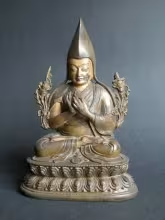
Tsongkhapa is an extremely significant figure in Tibetan Buddhism. His impact has been compared to that of Thomas Aquinas in the west (Dargyay 55) and his philosophy has been credited with initiating a “Copernican revolution” in his tradition (Reigle 1999). He is also particularly revered in the Theosophical tradition. David Reigle writes in Tsongkhapa and the Wisdom Tradition that, in addition to being a Buddha incarnation, he is “seen in Theosophical writings as being not only the reformer of exoteric Buddhism and the founder of the Gelugpa order, but also as the reformer of the esoteric teachings that we may call the Wisdom Tradition, and the founder, or at least re-organizer, of the secret school or Brotherhood in Tibet that the Mahatma/Bodhisattva teachers behind the Theosophical movement belonged to.” With the translation of a great many of Tsongkhapa’s writings into English, students of Theosophy have been made aware of some apparent discrepancies between his teachings and those of Theosophy. These are laid out by David Reigle in the above cited essay. As we will soon see these issues are merely illusory.
The First Fundamental Proposition of the Secret Doctrine
The first fundamental proposition of the Secret Doctrine teaches that there is an Absolute that is an “Omnipresent, Eternal, Boundless, and Immutable PRINCIPLE…which antecedes all manifested, conditioned, being” (Blavatsky 2014, 14). Reigle finds that this principle agrees very well with the “Great Madhyamaka” conception of the Jonang school that there is an inherently existent ultimate reality that is “other-empty” compared to the ever changing world of appearances, which is self-empty. The ultimate reality is empty of everything that is not itself, everything other (1999). Tsongkhapa refutes this and asserts that there is no ultimate nature to anything, only emptiness which is itself empty of any inherent being. Thus it is “self-empty.” The contrast appears very stark.[1]
This tension begins to resolve itself, however, in a footnote in David’s paper Theosophy in Tibet. Referring to the current Dalai Lama’s book The Gelug/Kagyu Tradition of Mahamudra, he writes “the 14th Dalai Lama states and provides considerable evidence that Tsongkhapa may in fact have held that there are two different correct views of reality, one of which is equivalent to a particular ‘empty of other’ (gzhan stong) view.”
In this volume the Dalai Lama writes:
Tsongkhapa’s Sakya teacher Rendawa was himself a vehement opponent of the Jonang view of ultimate reality. However even he asserted other-emptiness in his later writings. He writes:
The Dalai Lama writes that “Kaydrubjey, in his Miscellaneous Writings, has asserted that although Rendawa’s and Tsongkhapa’s writings on the topic have different manners of expression, they come down to the same thing” (1997, 235). The Dalai Lama ties all this in with a “restricted” Mahamudra teaching that Tsongkhapa had delivered “to Gungru Gyeltsen-zangpo and some others at Gaden Jangtsey Monastery” (230). He reinforces this further with evidence from many individuals who received Tsongkhapa’s unique Mahamudra lineage. This may be further supplemented by evidence from Michael Sheehy, who demonstrates that Gungru Gyeltsen and another direct disciple of Tsongkhapa, Khunkhyen Lodro Rinchen Senge, write positively of other-emptiness in their recently rediscovered writings.
The Dalai Lama explicates Tsongkhapa’s other-empty in terms of what is known in Vajryana as primordially pure light mind. The Dalai Lama writes that
So the light mind is other empty in that it is empty of being conceptual and of all fleeting adventitious defilements. In this sense, it is immutable and eternal. As the simultaneously arisen basis of samsara and nirvana, it is omnipresent and boundless. The Dalai Lama continues:
In addition to being other-empty (or other-void), the light mind is self-empty. It is void of “impossible ways of existing” i.e. it does not exist inherently; it is not ultimately established by rational analysis. It is a self-emptiness and this is primarily what distinguishes it from the Jonang tradition.
The Madhyamaka doctrine of self-emptiness is intimately connected with the doctrine of dependent origination, with which it is ultimately identical. Self-emptiness is the lack of intrinsic essence in all things, thus all things arise in dependence. Since all things arise in dependent origination (pratityasamutpada), they are essenceless, or empty. In one sense, dependent origination is the dependence of an object on its parts. Tsongkhapa gives as examples “persons, pots, and so forth.” All of these exist “without inherent establishment because of being imputed in dependence on their own collection [of parts]” (Hopkins 2008, 336). The constituent parts of these objects may be further broken down into parts, and so on, ad infinitum. In addition to this there is “dependence on a basis of imputation and in dependence upon conceptuality that imputes it” (356). This dependent origination applies even in the case of permanent and “uncompounded phenomena” like the noumenon, space, thusness, and analytical and non-analytical cessations (334-5). Examples of bases of imputation include “presentations of definiendum and definition, separative cause and separative effect, comprehension by such-and-such valid cognition, and so forth.” If ultimate and uncompounded objects could exist without being dependently originated in this respect then any phenomena whatsoever could. Further, since uncompounded phenomena can exist just fine without doing so inherently, there is no good reason to posit inherent existence in these cases (334-5).
There is also another sense of dependent origination, though. This is dependent origination as the doctrine of causality as seen in the relation between fuel and fire, seed and sprout, etc. Lal Mani Joshi writes:
This ties in with the second fundamental proposition of the Secret Doctrine, i.e. the “absolute universality of that law of periodicity, of flux and reflux, ebb and flow” (Blavatsky 2014, 17). H.P.B. writes: “That which is motionless cannot be Divine. But then there is nothing in fact and reality absolutely motionless within the universal soul” (2) and “Consciousness is inconceivable to us apart from change, and motion best symbolizes change, its essential characteristic” (14).
This change, motion, and “ebb and flow” that emptiness brings about has enormous implications on the level of the individual. Because of our dependently originated nature, or rather lack of inherent nature, there is no limit to how much we can change. “We can think of emptiness as like the clear, blue sky—a transparent space that is wide open. We are not blocked, obstructed, or tied down,” writes Guy Newland, explicating the role of emptiness in Tsongkhapa’s thought (7).
Further, because all things are empty they depend on everything else; they are interconnected. The Dalai Lama writes that the more we understand dependent origination, the more we may “begin to see that the whole universe we inhabit can be understood as a living organism where each cell works in balanced cooperation with every other cell to sustain the whole.” Because things exist in this way, they exist without duality and this interconnection implies a moral duty towards others. “If then, just one of these cells is harmed, as when disease strikes, that balance is harmed and there is danger to the whole. This, in turn, suggests that our individual well-being is intimately connected with that of all others and with the environment within which we live,” he writes. “It also becomes apparent that our every action, our every deed, word, and thought, no matter how slight or inconsequential it may seem, has an implication not only for ourselves but all others, too” (1999a, 40-1).
Fortunately, there are no built-in limitations to how compassionate we can grow. “Right now, our powers to help others may be limited, but emptiness is the lack of chains preventing us from becoming more wise and loving,” Newland writes. “It is the absence of bars on the door, the freedom from any built-in limit on what we can be. How wise can we become? How loving? When we wonder about this, let’s not impose limitations that are not part of reality…” (7).
Returning to a more macroscopic perspective, the Tantric traditions which Tsongkhapa and the Gelug tradition have commented on and regard as authoritative speak of the world arising from the nature of mind, luminous clear light. Nagarjuna’s disciple Aryadeva writes, “The entire world is dependent [on a cause], for something independent can never arise. Its [the world’s] cause is luminosity (prabhasvara); luminosity is the universal void (sarva-sunya)” (Reigle 2013b). The Kalachakra Tantra calls this level of mind “the space vajra pervasive with space” (Berzin 2003). It is called the space vajra because it is “the space-like exalted wisdom of clear light, which is of an undifferentiable entity with the space-like reality of the emptiness of inherent existence” (Dalai Lama 1999b, 258). It may thus be correlated with the “absolute abstract Space” of the Theosophical Absolute which represents “bare subjectivity” (Blavatsky 2014, 14). McCagney writes that “the image of space,” which is understood to be luminous, “is the root metaphor for Nagarjuna’s conception of sunyata [emptiness or voidness]” (xi).[3] In Nagarjuna’s understanding, “all events, and most importantly, samsara and nirvana, are not distinct because they are all like the sky, like [luminous] space (akasa), without limits or boundaries which separate and distinguish them” (xx). To lack a distinct existence while appearing to have one is to exist like an illusion. Thus in Theosophy, space (or voidness) is “our objective universe in the sense of its unreality and illusiveness” (Blavatsky 1930, 200). The emptiness of all dharmas is limitless and boundless like space while these dharmas at the same time inhabit a boundless and infinite space. This “space” is the dharmadhatu (Reigle 2013d) and the dharmadhatu is identical with the space vajra (Vesna Wallace 153). Theosophical Space is also “the field for the operation of the eternal Forces and natural Law, the basis… upon which take place the eternal intercorrelations of Akasa-Prakriti [space-substance], guided by the unconscious regular pulsations of Sakti [energy]…” (Blavatsky 1968, 423).
The account of luminosity bringing about the world may be complimented with the sutra account of the world arising from the collective karma of sentient beings in the form of primordial wind (Reigle 2013a). Reigle writes: “According to Buddhism, karma is not just action per se but rather is volitional action, and there can be no volitional action without mind. So the nature of mind, luminosity, must be there for karma to occur” (Reigle 2013b). This primordial wind can be correlated with prana and the unmanifested “great breath,” or maha-prana, of the Stainless Light Commentary on the Kalachakra Tantra (Reigle 2013d). The ultimate reality “is a life-principle, or a sublime prana (mahaprana), which pervades the entire universe, manifesting itself in different forms. As such, it is said to be present within the heart of every sentient being. As a sublime prana, it is recognized as the source of all utterances, even though it is unutterable itself.” (Vesna Wallace 152-3). The Secret Doctrine likewise informs us that “absolute abstract Motion,” another aspect of the Absolute, may also be called “The Great Breath,” which represents “the perpetual motion of the universe” (Blavatsky 2014, 2).
Luminosity and wind are like a rider and its mount. The Dalai Lama writes that “Tsongkhapa has mentioned that the inanimate environment and the animate beings within it are all the play or emanation of subtlest consciousness and subtlest energy-wind—in other words, simultaneously arising primordial clear light mind and the subtlest level of energy-wind upon which it rides.” The Jnanavajra-samuccaya-tantra likewise says that the “very consciousness that is arisen from luminosity is mind (citta), thought (manas). All dharmas, having the nature of defilement and purification, have that [luminosity] as their root. From that [luminosity] come the two [false] conceptions, self and other. That consciousness has wind as its vehicle.” The Book of Dzyan as translated in the Secret Doctrine likewise says that “Fohat [cosmic prana] is the steed and the thought is the rider.”[4] Aptly summing this esoteric tradition up, the Dalai Lama writes: “This is the Buddhist explanation for what is called the creator in other traditions” (Reigle 2015a).
These two, simultaneously arising clear light mind and its pranic energy wind, are seen to be a single element in the final analysis. The Dalai Lama writes that from the perspective of Vajrayana “at the most fundamental level, no absolute division can be made between mind and matter. Matter in its subtlest form is prana, a vital energy which is inseparable from consciousness. These two are different aspects of an indivisible reality. Prana is the aspect of mobility, dynamism, and cohesion, while consciousness is the aspect of cognition and the capacity for reflective thinking” (2005, 110). Tsongkhapa understood that these two, mind and matter, are mutually entailed. Douglas Duckworth writes that “by unrelentingly affirming the duality of external objects and internal minds, Tsongkhapa implicitly collapses this duality… as an ultimate structure of the world. He does so by showing that internality cannot exist without externality, and thus that the notions of an internal mind and external matter are both co-constituting, conceptual constructions” (2015b, 213). This takes us right to Theosophy’s primordial plastic element that is not yet differentiated into either mind or matter. William Judge writes that “the whole universe is made of spirit [or mind] and matter, both constituting together the Absolute. What is not in matter is spirit, and what is not in spirit is matter; but there is no particle of matter without spirit, and no particle of spirit without matter” (70).
Primordially pure luminosity (and energy wind) is universal; it gives rise to the “macrocosmic evolution/emanation of the known universe.” According to Tsongkhapa it is “mother luminosity” (Sparham 21). It may be identified with the Theosophical Alaya (or alayavijnana) i.e. the Over-Soul of the third fundamental proposition (“Alaya”). Many Tibetan Buddhist traditions also identify light mind with alayavijnana but the Gelugpas avoid this terminology (Berzin 2002) for reasons we shall discuss in the next section. However they do acknowledge that “alayavijnana” such as it used by Nagarjuna and the tantras refers broadly to cognition (Dargyay 63) and “the mental consciousness that takes rebirth” (Hopkins 1996, 388), while “clear light subtlest level of consciousness underlies every moment of cognition” (Berzin 2012) as well as being the basis of rebirth for sentient beings (Jinpa 141). So this terminology is not entirely inappropriate even from a Gelug perspective.
This leads us into the next point: we may say that each sentient being has its own individual pure light mind which exists latently, covered by numerous adventitious defilements (Preece 280-2); our mindstreams have been impure from beginingless time but have the potential to be purified (Jinpa 139). For Tsongkhapa, the light mind as it is cultivated in the process of individual meditation is “child luminosity” which may come to mingle with “mother luminosity,” or Dharmakaya, thus becoming aware of ultimate reality (Sparham 21). Likewise in the modern Theosophical tradition Manas must be purified so the latent potential light of Buddhi, a ray of Alaya or Atman, may shine forth (“Alaya”). So we may say that the realization of the individuated primordially pure light mind is in Theosophical parlance the union of higher Manas with Buddhi.
So what is this ultimate reality that the light mind looks upon? For Tsongkhapa, ultimate reality is not ultimate in the sense that it inherently exists: “It can be said that the ultimate is other-empty in that the ultimate is not the conventional, but it is empty of inherent existence, and thus the ultimate is a self-emptiness and thus an empty emptiness” (Hopkins 2008, 355). Rather, it is ultimate truth because it appears as true to “a [rational] consciousness of meditative equipoise directly realizing emptiness” (332). So for Tsongkhapa, ultimate reality is emptiness itself. Aryadeva writes that “he who sees one sees all; for voidness of one thing is the voidness of all things, voidness is the nature of all things” (Joshi 205). Commenting on this, Tsongkhapa’s famous disciple Gyel-tsap writes:
Jeffrey Hopkins clarifies that “the extraordinary mode of the direct [nondual] cognition of emptiness—in which the object, emptiness, and the subject, the wisdom consciousness, are undifferentiable like fresh water poured into fresh water—allows for cognition of the emptiness of all objects” (1996, 193-4).
Emptiness is undifferentiable because it is in nondual union with its dependently arisen appearances (Jinpa 182). Dependently originated appearances “do exist, but they do not at all exist on their own; they are ascribed, imputed, designated.” They are conceptually “sliced out” (Newland 2011, 64) of nondual reality as it is actually is; in actuality everything arises in dependence on everything else and nothing exists in isolation. Dependently originated appearances are nondual because they lack inherent existence; they are empty. The Stainless Light says that “conventional reality has the form of emptiness and emptiness has the form of conventional reality” (Vesna Wallace 154). Tsongkhapa likewise writes: “Appearance dispels absolutist extremism and emptiness dispels nihilism; when emptiness dawns as cause and effects, you will not be deprived by any extremist views” (Thurman 1984, 170). For Tsongkhapa “it is in Nirvana that samsara is embraced completely. In the ultimate reality, there is no duality of any sort, and samsara and Nirvana are the same actuality” (159). Along these lines, we have seen previously that mind and matter are fundamentally isolates of the same element. It is also the case, however, that this element is identical with its emptiness. As we read in the Vimalakirti Sutra:
H.P.B. likewise writes that the Absolute is both “limitless void” and “conditioned fullness.” But it is only voidness insofar as it concerns the “finite minds” of sentient beings and only fullness according to “mayavic [illusory] perception” (2014, 8). In and of itself the Theosophical Absolute is impossible to speculate on “since it transcends the power of human conception and could only be dwarfed by any human expression or similitude. It is beyond the range and reach of thought – in the words of Mandukya [Upanishad], ‘unthinkable and unspeakable’” (14). H.P.B. writes that “absolute existence” can’t be pictured to “our imagination as any form of existence that we can distinguish from Non-existence” (43). This may be supplemented with the recent finding of John Abramson who cuts the Gordian knot of Absolutist and non-Absolutist scholarly accounts of emptiness.[6] He maintains that emptiness is indeed empty of itself in the realm of conventional discourse but from the ultimate perspective nothing can be asserted about it. These two levels of discourse are thus seen to be mutually supportive.
This is true also for Tsongkhapa. For him, conventional knowledge is crucial to realizing ultimate reality. Guy Newland asks: “Without reliable information from our senses, how could we even infer that appearances even to those very senses are deceptive? In Tsongkhapa’s system the foundation for the bridge between benighted ordinary existence and the awakening of buddhahood is the aspect of reliability in ordinary, healthy minds” (2011, 69). Tsongkhapa “has the audacity to argue that the Absolute, the Ultimate Truth, Reality, can be proven, expressed, and experienced, and that human reason can thus serve as the solid ground for ethical, creative, and liberative action in the world” (Thurman 1984, 150-1). He maintains that from the perspective of dualistic wisdom, the realization of ultimate reality (which is other-empty in that it is empty of being the conventional) is an object which is experienced by a subject, clear light mind of transcendent wisdom (which is other-empty in that it is empty of being a conceptual layer of mind) although from the perspective of one in meditative equipoise it is “fresh water poured into fresh water”; there is no distinction. Nondual wisdom is thus supported by the dual wisdom of conventional, empirical reality. “Just as nondual wisdom requires dual empirical wisdom as its grounding, so dual empirical wisdom requires nondual wisdom to validate its epistemic authority” (Thakchoe 2007, 126). However this duality of dual and nondual wisdom too is just another example of the interdependence of all things, and thus the lack of duality in all things; dual wisdom is based on concepts and “allows us to distinguish suffering from happiness, persons from rocks, virtue from nonvirtue” whereas nondual wisdom is simply things as they actually exist (Newland 2011, 59-60).
From the perspective of dualistic wisdom, the nondual experience of ultimate reality is indeed the union of emptiness and appearance. This, however, is only a “concordant ultimate.” That is to say, it is concordant with the ultimate as it is actually experienced but is not itself that ultimate (Vose 102-4). On the level of the conventional, nothing is free of conceptual designation, not even nirvana (B. Wallace 69), but the ultimate as it is actually experienced by the meditator is beyond conceptual thought (Vose 102-4).[7] Tsongkhapa writes that if “there is anything expressible from the ultimate standpoint it should be expressed. From the ultimate standpoint, however, what is to be expressed has ceased, and thus it appears to be nonexistent.” This non-conceptual experience is nothing other than the experience of nirvana (Thakchoe 2007, 88). Thurman sums up Tsongkhapa’s Absolute and its relation to the conventional well: “Everything disappears in ultimacy-seeking experience; ultimate reality is by definition transcendent and undifferentiated. And yet the world is not destroyed. It is there on the surface, when not subjected to absolutist standards. In a sense it is the surface of the ultimate, which is ultimately one inconceivably multifaceted surface” (1984, 168).
The Third Fundamental Proposition of the Secret Doctrine
As we saw in the previous section the individuated primordial mind of pure light may be identified with the Over-Soul of the third proposition. This terminology derives from the Yogacara school where it is understood as the “storehouse consciousness” of karmic impressions. All of material existence is understood to be derivative of these karmic traces stored in the alayavijnana consciousness. Thus it is an idealist view where everything is merely a mode of consciousness. Tsongkhapa rejects this. So where does this leave Theosophy? To find out we must examine the Prasangika Madhyamaka tradition to which Tsongkhapa adhered and which H.P.B. judges superior to Yogacara and to hold the “views… of the most secret Schools” (Blavatsky 1985, 439).
Jan Westerhoff, in a piece entitled Nagarjuna’s Yogacara, addresses Nagarjuna’s views on Yogacara and the alayavijnana. Westerhoff cites Nagarjuna’s Bodhicittavivarana to demonstrate “a circular dependence structure” between mind and matter. He writes:
The same is also true for Nagarjuna’s authoritative interpreter Candrakirti. C.W. Huntington writes:
With this groundwork laid we can determine the nature of the alayavijnana that Tsongkhapa rejects. In his final written views on alayavijnana he repudiates the alayavijnana as having undue ontological weight relative to external objects, basically reiterating what Nagarjuna said. He writes that the alayavijna would make “shapes, sounds, etc… mere appearances without objective content” whereas in actuality “the ontological status of a knowable and knowing are equated. If one were not to exist the other would not either” (Sparham 21-2). Tsongkhapa’s celebrated disciple Kaydrubjey says the same thing in his rejection of the alayavijnana in his Stong Thun Chen Mo. He writes that if one accepted the alayavijnana “it would be necessary to accept that everything that appears, both in the external world and internally within the bodies of sentient beings, is the mere appearance of the evolution… of the latent potentialities of the foundation consciousness” (Dge-legs-dpal-bzan-po 317-8). Since as we have seen earlier Theosophy also rejects the notion that consciousness has more ontological primacy than substance there is no contradiction here.
We saw earlier that the Over-Soul is identical with the pre-individuated primordial mind of pure light. That being the case, where do the karmic impressions reside? For Tsongkhapa the “mere I, which is the object of our instinctual I-consciousness, is the basis upon which karmic imprints are said to be carried from successive stages of an individual’s personal life history” (Jinpa 129). In line with the Madhyamaka tradition that preceded him (Arnold 2010), Tsongkhapa asserts that the self or the “mere apprehension of I and mine is [conventionally] valid” (Hopkins 1996, 194). He writes: “There are two senses of ‘self’: (1) one that is conceived with a nature that is essentially real and (2) one that is held in mind with the mere thought ‘I am’. The former is an object of negation by reasoning and the latter is not negated, for it is maintained to be conventionally real” (Duckworth 2015b, 211). Evan Thompson helpfully clarifies this conventionally real self from the perspective of phenomenology. He writes:
When we realize the primordial mind of pure light this “expand[s] the horizon of an individual’s basis of designation for his or her own self. In other words, it broadens the scope of a person’s natural, intuitive I-consciousness” (Jinpa 141). Thus karmic impressions are “imputed on the conventional ‘me’ that can be imputed on the continuum of clear light subtlest mind” (Berzin 2012).[9] The light mind “also gives greater explanatory power to the pan-Buddhist theory of rebirth. For Buddhists can now argue that continuity through successive lives is ensured through the uninterrupted continuum of this subtle mind of clear light” (Jinpa 141).
There is still more to say about the karmic impressions, however. As we learned in the previous section, “subtlest mind and energy-wind are forever inseparable. In fact, all levels of mind operate on the basis of some form of energy-wind, from which they are indivisible.” In tantric traditions revered by the Gelugpas such as the Guhyasamaja Tantra, “[k]armic ‘seeds’ or tendencies, as well as karmic potentials, come along with the stream of continuity of our subtlest mind and energy-wind. They are not an integral part of the package, however. Like karma itself, they are subtle forms that merely give a temporary shape to the flow of our subtlest energy-wind” (Berzin 2010, 56-7). Complementing this, B. Alan Wallace writes of theKalachakra tradition that “karmic imprints (vasana), memories, and so on are carried from one life to the next by way of the jiva, a continuum, or field, of prana that accompanies the continuum of subtle consciousness that carries from lifetime to lifetime” (Vimal). Likewise in Theosophy the karmic traces are stored in a field of subtle prana called the auric egg (Hesselink).[10]
Self-Reflexive Awareness
David Reigle brought a third issue to the attention of Theosophists in a post on the Theosophy Nexus forum: svasamvedana, “self-reflexive awareness” or simply “self-awareness.” In the Buddhist tradition, self-reflexivity is identified with luminosity (Williams 20). Along with the alayavijnana, Tsongkhapa rejects svasamvedana in his “eight difficult points.” Conversely, HPB accepts it (2013b) and identifies it as paramartha, which may be translated “the highest or whole truth, spiritual knowledge.” This is the opposite of samvriti, which is merely relative truth (“Paramartha”).
Before we begin, it will be useful to define a couple of key terms: “intentionality” and “foundationalism.” Intentionality is the quality of mental states that is directed towards their objects; it is a defining mark of consciousness and subjective experience. The Internet Encyclopedia of Philosophy sums it up: “If I think about a piano, something in my thought picks out a piano. If I talk about cigars, something in my speech refers to cigars. This feature of thoughts and words, whereby they pick out, refer to, or are about things, is intentionality. In a word, intentionality is aboutness” (O’Madagain).
Epistemological foundationalism, on the other hand, is the view that “there exist some foundational cognitions or beliefs (1) which are either self-evident or self-justifying or, at the least, not evident or justified by reference to any other cognitions or beliefs and (2) upon which all other cognitions or beliefs are founded insofar as they can be derived therefrom by an acceptable method” (Drummond 52). Examples of this include Descartes cogito argument and, in the Indian context, the Nyaya school’s assertion of foundational epistemic instruments (pramanas). Foundationalist accounts are supposedly able to withstand analysis into the ultimate nature of things (Bernier). The Madhyamaka alternative to this view is a variety of coherentism in which the epistemic instruments are justified by their epistemic objects (prameyas) and vice versa. “We are entitled to rely on epistemic instruments… just because they deliver epistemic objects; we are entitled in turn to confidence in our judgments about our epistemic objects just because they are delivered by these epistemic instruments” (Garfield 2010, 344). In other words pramanas and prameyas are dependently originated.
There are several conceptions of svasamvedana that are posited in the Indian Buddhist tradition and modern philosophy of the mind. The first is the nondual idealistic self-awareness of the Yogacara school. It is associated with Dignaga and Dharmakirti, exists on an ultimate level of discourse, and is considered the “foundation… and pinnacle of knowledge” (Duckworth 2015b, 207). Dan Arnold writes that it “seems to denote a special kind of (intentional) cognition—that kind, specifically, whose object is other cognitions.” Any cognition must be an object of svasamvedana in order to simply be a cognition on this account (2005, 77). Svasamvedana is “not only the means by which experience arises but also its content: everything, subjects and objects, arise in and as awareness. In this interpretation, experiential reality is nothing but awareness; the world is irreducibly singular (or rather, nondual) even though it presents itself as a duality of subjects and objects” (Duckworth 2015b, 208).
Tsongkhapa and other Prasangika Madhyamikas reject this conception because it is presented as a foundational source of knowledge and privileges consciousness over matter in much the same way as the Yogacara alayavijana (209). As we have seen previously Theosophy rejects the notion that consciousness has primacy over matter so this can’t be the Theosophical svasamvedana. The Prasangikas refute this conception by noting that “if consciousness is self-conscious and that if the two (consciousness and self-consciousness) exist in a non-dual relationship with one another, then that which is consciousness must be self-conscious, and that self-consciousness must be a consciousness which is also self-conscious, and so on” (Blumenthal 223). Thus, an infinite regress. It is also claimed that memory can only exist on account of this sort of self-awareness; since we remember being conscious there must have been a previous cognition of that conscious cognition. But Tsongkhapa notes that memory is only the case of a cognition of a previous object. He writes that “the previous state of consciousness perceives a previous object, and this is the cause of the effect, which is the later memory” (Garfield 2006, 220). It is not the cognition of a cognition of a previous object. If this is taken to be the case once again an infinite regress ensues (Blumenthal 224).
Closely related to the Yogacara account is the reflective self-awareness defended by modern philosophers David Armstrong and David Rosenthal. This self-awareness is a transitive cognition and “is the object of another cognition, a higher-order thought or perception.” It is a “second-order awareness or introspective cognition” (Duckworth 2015b, 209). Like the Yogacara account, this understanding also falls victim to an infinite regress (Caston 754).
The third sense is pre-reflective self-awareness. It is associated with Plato, Aristotle (Caston), Plotinus (Gerson 1997), the Buddhist thinkers Santaraksita and Mipham, and more recently with Edmund Husserl, Jean-Paul Sartre, and David Zahavi. This self-awareness, which is merely conventional, is “part in parcel with awareness [or intentionality] itself” and “is held to be an intransitive cognition without a direct object, not an awareness of something. Thus self-awareness is not known like any other cognized object” (Duckworth 2015b, 209). Dan Arnold writes that it is simply “whatever it is… that is constitutive of subjectivity” (2005, 77-8). This svasamvedana can’t take itself as its own object. Santaraksita’s disciple Kamalasila writes that self-awareness “does not mean that it is the cogniser of itself, what is meant is that it shines, becomes manifest by itself, by its very nature, just like the light diffused in the atmosphere” (Joshi 204-5). It infallibly delivers our conscious state even if we may misunderstand or incorrectly describe that state (Gerson 1997, 161). Although sometimes presented as foundationalist, this is true neither for the Buddhist (Bernier) nor the Continental formulation (Hopp).
Pre-reflective self-awareness also necessarily presupposes a witness-consciousness (saksin) such as may be found in Advaita Vedanta (Albahari 2009, Gupta 145-68). This “luminous” witness merely observes phenomena, not being the agent of any of them (Albahari 2009, 65). In Advaita, cognitions “are not present to themselves, as in the Yogacara view. Rather, conscious states are immediately present to the self as pure witnessing subjectivity. The Atman, as pure consciousness, is the source of illumination for any phenomenon whatsoever, ʻinternalʼ or ʻexternalʼ, and cannot itself become an object of cognition” (Mackenzie 183). Miri Albahari has recently made a strong philosophical case for its reality as a datum of experience (2009). Since H.P.B. writes that the highest level of consciousness can’t observe itself (1985, 439) she belongs to the pre-reflective, witness-consciousness tradition.
Paul Williams wrote a book (The Reflexive Nature of Awareness) in which he delineates the main senses of svasamvedana outlined above and defends the second one. This was followed by a study and translation of Santaraksita’s Ornament of the Middle Way by James Blumenthal in which he noted that the arguments of Tsongkhapa and other Gelug thinkers are directed at the Yogacara conception rather than Santaraksita’s formulation.
In response to these authors Jay Garfield wrote a paper titled The Conventional Status of Reflexive Awareness. In this paper Garfield defends the thesis that Tsongkhapa’s arguments are directed at both senses of svasamvedana. This paper is very valuable for its translation and study of the classic Indian Prasangika Madhyamaka treatments of this issue. That said, it is also fatally flawed in its acceptance of an eliminativist, materialist account of the mind ala Paul and Patricia Churchland. Tom Tillemans has lately demonstrated that this understanding is incompatible with Madhyamaka. In addition to going against the Madhyamaka analysis of mind and matter as dependently originated it also runs afoul of the man in the street’s conventional understanding of reality, something philosophers of the Madhyamaka are very concerned to protect (2015). Garfield also takes himself to be defending public and conventional concepts along Madhyamaka lines but as Christian Coseru points out:
Following on his eliminativist understanding of consciousness, Garfield posits that we do not have privileged access to our own minds. We know our own minds only inferentially like other people know our minds and often know it less well than they do. Although agreeing with Garfield’s reductionist enterprise Raziel Abelson considers this claim to be “unwarranted” and “dubious” and notes that the psychological study Garfield cites for this is “philosophically confused” and “deals only with intentions, not with… perceptual experiences” (342). Further, Tsongkhapa did in fact hold that individuals do have privileged access to their own minds except in exceptional circumstances such as those involving psychic activity (B. Wallace 67-9).
A linchpin of Garfield’s presentation is Paul Williams’ association of svasamvedana with Descartes’ foundationalist cogito argument. Paul Bernier wrote what is really a rebuttal to both Garfield and Williams by demonstrating that Descartes’ cogito is contrary to Santaraksita and Mipham’s svasamvedana, being as it is a supposedly ultimately established foundation for knowledge whereas svasamvedana is not presented or understood as such by either; it is conventional and therefore is obvious even to cowherds. Linking this controversy with current philosophical debates on “first person authority” and demonstrates that while the conventional assertion of the cogito argument inevitably results in assertion of it on the ultimate level this is not the case for svasamvedana.
To make his case Garfield analyzes several quotations from Tsongkhapa. The first of these refutes the notion that memory proves self-reflexivity (2006, 220). As Evan Thompson shows, however, these arguments have no purchase against the understanding of memory found in writers of the pre-reflective tradition such as Husserl (2011). Next, Garfield presents a quote refuting the notion that introspection demonstrates reflexive awareness (ala the reflective self-awareness view) by pointing out that “the denial of reflexive awareness is consistent with the distinction between subject and object with respect to all cognitive states that are directed inwards” (2006, 220). From this Garfield concludes: “When we are aware of our own inner states, we are aware of them as states of a particular kind. And, in general, this kind of conceptually characterized perception is mediated and fallible. In that case, mundane introspective consciousness should be taken to be mediated and fallible in the first place, and hence to provide no ground for positing reflexivity” (221). In reply to notions like this, Lloyd Gerson notes that “[p]hilosophers who dismiss infallibility as an illusion are often relying on a confusion between introspection and self-reflexivity” (1997, 160). Introspection may be mistaken but “to mistake one’s own state A for B, one must first cognize A… Self-reflexivity is just the capacity for cognizing our own states without interpretation, so to speak” (161). Lastly, Garfield presents a passage to the effect that a consciousness that nondeceptively takes itself as an object would beg the question as to its own authority. But the pre-reflective self-awareness can’t take itself as an object and our introspective analysis of it is not guaranteed to be nondeceptive; this argument only works against the Yogacara conception. In fact this is the case for all of Tsongkhapa’s arguments presented by Garfield. So we are back to what Blumenthal stated: the arguments of Tsongkhapa and other prominent Gelugpas are not formulated against Santaraksita’s version of svasamvedana.
Dan Arnold further reinforced Blumenthal’s point by demonstrating that Candrakirti’s arguments (upon which Tsongkhapa’s are based) are completely ineffective against Santaraksita’s svasamvedana, which Arnold fruitfully compares to Kant’s “transcendental unity of apperception,” because it is in essence a different concept. He writes that “while Candrakirti’s critique targets the view on which svasamvitti [svasamvedana] is considered a particular kind of intentional cognition (considered, that is, to display intentionality), Santaraksita’s is more like the view that svasamvitti is itself ‘intentionality’” (2005, 78). It is simply a subject’s experience of an object.[11] That is, experience is necessarily subjective and at least admits of the potential for intentional description. In this view “there is no perceptual experience that is not someone’s perceptual experience, no experience that is such that its subject could not attend to it, under any propositional attitude, as his experience” (2012, 90). Arnold would build on these findings in his later works, the most recent volume of which is Brains, Buddhas, and Believing. According to him, Madhyamaka from Nagarjuna onward is fundamentally anti-foundationalist and its defense of conventional truth (i.e. reality as it is perceived by ordinary beings and conveyed in their linguistic concepts) is a defense of an intentional description of reality and thus of intentionality itself and thus what Santaraksita is pleased to call svasamvedana.
Following on this, no one brought these themes of anti-foundationalism and defense of conventional reality out in the open as strongly as Tsongkhapa.[12] So we can say that insofar as intentionality is a core part of Candrakirti’s project it is also a part of Tsongkhapa’s. Tsongkhapa “claims that an unreflective stance on reality shares the same features with conventional truth” (Duckworth 2015b, 212). This unreflective stance satisfies without analysis (Eckel 188-90); it is an intentional description of reality that does not discriminate between whether things inherently exist or not. This stance is thus the awareness of mere selves, mere I’s, who posit conventional, conceptual reality “through the force of [that] awareness” (Newland 2011, 63). He writes: “We hold that what exists conventionally is: (1) renowned to a conventional cognition [i.e., consensus], (2) not invalidated by another conventional valid cognition knowing it to be that way, and (3) not invalidated by reason that correctly analyzes its [ontological] reality, that is, whether it intrinsically exists or not” (211). This is similar to Husserl’s “Principle of All Principles” which states that “every originary presentive intuition is a legitimizing source of cognition… everything originarily… offered us in ‘intuition’ is to be accepted simply as what it is presented as being…” (Hopp 208). Husserl, like Tsongkhapa and other Madhyamikas, is concerned with “protecting the sense of assertions made in the natural attitude from philosophical falsifications of them” (213).
Although Tsongkhapa did not speak of self-reflexive awareness (svasamvedana), he had an equivalent term: luminosity (prabhasvara). The current Dalai Lama, the most illustrious modern representative of Tsongkhapa’s tradition, gives the following definition:
This agrees completely with Kamalasila’s definition of svasamvedana given above. Further, Jinpa writes that Tsongkhapa’s understanding of Tathagatagarbha (Buddha-nature) in terms of Vajrayana “is an understanding of garbha principally in the subjective terms of what is known in a genre of literature belonging to the Vajrayana school as ‘inner radiance’ or ‘clear light’… In this view, all cognitive experiences are perceived to be permeated by an underlying nature of mere luminosity” (140). For Tsongkhapa, luminosity is paramartha (Sparham 21).
An additional feature of the mind is that it is aware. While luminosity is the mind’s nature, awareness is its function i.e. it has an intentional object as its content. Paul Williams writes that the “definition of consciousness as luminosity and awareness is common in [Gelug] texts” and also notes the identity between luminosity and Santaraksita’s conception of svasamvedana as that which distinguishes sentience from insentience (26-7).
Another indicator of the significance of intentionality for Tsongkhapa and his school is their account of universals. Candrakirti had argued against a view that would reduce universals to particulars, demonstrating that particulars and universals are mutually entailed. Thus, the intentional description of reality remains irreducible (Arnold 2010). Alone among Tibetan Buddhist schools, the Gelugpas follow Candrakirti in postulating universals. Tsongkhapa writes that “there are two [types of] universal: that which is a nonthing and that which is a universal [and] a thing that is concomitant with specifically characterized particulars” (173). Like Aristotle, the Gelugpas are “moderate realists” on the issue of universals; universals do not exist apart from particulars. As Dreyfus writes: “Particulars and universals are relative notions that derive from conceptual distinctions. Hence, even though these notions are grounded in reality, they do not directly reflect its structure” (173). Platonic Forms (which are favored by Theosophists), however, are often taken to be incompatible with this view. Aristotle’s “Neoplatonist” commentators reconciled his universals with the Forms by noting that these do not serve the same function; they are paradigms rather than something which particulars participate in. Thus they distinguish between universals as the explanandum and Forms as the explanans (Gerson 2005, 209-42). It may be possible to reconcile Platonism with Prasangika Madhyamaka universals in the same way, especially since “Forms are dependent on the Idea of the Good in Republic and the identity of intellect and Forms is cognitive identity: that is, the self-reflexive awareness of one’s cognitive state” (216). The Forms are contingent and thus not inherently existent[13] and they are identical with the cognitive state of Plato’s Demiurge who is the intellect of the soul of the universe. The Forms themselves are the universal nature of intellect shared by all individual intellects (1994, 48-9). It should be noted that this is not the same as the Yogacara view; the Forms are not taken as direct intentional objects (1997, 160-1) nor are they conceptualizations (2005, 216); this is thus the kind of self-awareness signified by “luminosity.” Because of their identity with cognition, these Forms are not static; Plato argues against the static view in the Sophist. For him “motion, life, soul, and thought are present in the really real… The Demiurge, cognitively identical with Forms, imports a sort of motion into the really real world. That motion is what in Laws is called the ‘motion of intellect’” (216-7).
Additionally very relevant to our consideration of svasamvedana is that Tsongkhapa’s understanding of memory, which he bases his understanding of the conventional I-consciousness on (Jinpa 123-30), is extremely similar to that of the pre-reflective self-awareness understanding of the phenomenological tradition of Husserl which we discussed earlier and which is substantially similar to Santaraksita’s account. Both are based on the reflexive “I-making” (Thompson 179) of the mindstream “that appropriates [all] three temporal stages” of the past, present, and future. Tsongkhapa writes, “The individual stages are not mere distinct points of preceding and succeeding instances with no gaps in between; rather, they form parts of the whole.” (Jinpa 136). Likewise Husserl writes that time consciousness entails three intentional processes: primal impression (which corresponds to the present), retention (directed toward the past), and protention (directed toward the future), all of which are necessarily self-reflexive (Thompson 164). This structure constitutes a unity. Because of the nature of time consciousness past memories necessarily involve a subjective I-consciousness. Both Tsongkhapa and Husserl understand memory to be a “representation” of a past experience. It is not that the memory “‘really’ contain the past experience, but instead contains it only intentionally and in this way ‘intentionally implicates’ it” (Thompson 171). This is because “the memory experience and its antecedent, the perception itself, also share the same intentional object” (Jinpa 128). This finding is very significant in that the subject of memory was a large area of disagreement between the Prasangika Madhyamikas and the tradition of Dignaga and Dharmakirti.
We may close with the following instructive passage from the Secret Doctrine on this subject:
Conclusion
We have seen that Tsongkhapa’s written teachings agree in every fundamental point with the teachings of Theosophy we have examined. Beyond simply defusing an incipient threat to the modern Theosophical tradition, however, I hope this essay has given a hint of what studying the philosophy of Tsongkhapa has to offer Theosophy. David Reigle has made a strong case that the centennial attempt of the Trans-Himalayan brotherhood to present eastern wisdom to the west came in the form of Tibetan Buddhism (2006). This being so, the translation of Tsongkhapa’s writings must surely be one of the most significant parts of this effort. He is a rich resource of wisdom that can benefit any sincere seeker of truth.
Appendix I: Jonang and Gelug Views in Comparison with Theosophy
Douglas Duckworth asserts that there are actually deep points of agreement beneath the surface of the Gelugpa and Jonangpa systems (and the Nyingmapa system besides). These points are as follows:
- “phenomena do not exist in the way they appear to an ordinary being (in which case appearances do not accord with reality)”
- “appearance and reality accord without conflict in the undistorted perception of a buddha”
- “the undistorted perception of ultimate truth is not the distorted appearance of relative truth (other-emptiness)”
- “relative phenomena are not found when their ultimate nature is analyzed (emptiness of true existence)”
- “emptiness in essence is inexpressible (the ultimate of Prasangika-Madhyamaka)”
- “in none of these traditions is emptiness the utter negation of everything – it is not utter nihilism because some type of presence remains” (Duckworth 2013, 103).
Both schools, then, assert some form of other-emptiness and self-emptiness, a non-conceptual Absolute, an appearance/reality disjunction that is not present for an enlightened being, and an abiding presence that is not negated by ultimate analysis. So what are the real differences in the Jonangpa and Gelugpa conceptions?
The Jonangpas say that although in meditative equipoise nothing can be asserted about the ultimate, in post-meditation it may be said to exist inherently. Thus it is empty of everything other and withstands ultimate rational analysis. To be empty of everything other is to be empty of everything conventional. Conventional appearances, however, do not exist at all since they are self-empty and can’t be found in the only reality that actually remains as the abiding presence, the Absolute. Conventional appearances seem to the unenlightened mind to exist as the abiding presence, but in reality they do not even exist in the abiding presence, just as the horns of a rabbit and the son of a barren women do not. Realized beings who know the Absolute do not see these unreal appearances. To assert that conventional appearances exist is eternalism and to deny that the Absolute really exists inherently is nihilism (Duckworth 2015a).
The Gelugpas also assert that there is nothing to be asserted about the ultimate in meditative equipoise. However, post-meditation it may be asserted that it is self-empty i.e. it does not have an inherent existence and does not withstand ultimate analysis. It may also be allowed that it is other-empty insofar as it is free of adventitious defilements and impossible ways of existing. Conventional appearances are conventionally real as they always have been i.e. they exist but they do not exist in the way they appear to the unenlightened mind. They are “illusion-like” but not completely non-existent. While they are not found by ultimate analysis they are also not nullified by that analysis like the horns of a rabbit or the son of a barren woman are (Garfield 2010). As dependently originated appearances they are identical with their emptiness and can be understood as an isolate of the concordant Absolute. Thus they exist as an abiding presence (Vose 102-4). To not exist inherently is to be freed from eternalism and nihilism.
Which school, then, corresponds most closely to Theosophy? David Reigle has interpreted Theosophy in terms of the Jonang system. He sees commonality because the Jonang doctrine, like Theosophy, says there is a something “beyond what can be postulated by the mind” (2004, 15) whereas the Gelugpas refute an Absolutist interpretation of Madhyamaka (14). He cites as an example the Absolutist interpretation of T.R.V. Murti. According to Robert Thurman’s study of Tsongkhapa’s Essence of True Eloquence, however, the problem with Murti’s interpretation from a Gelugpa perspective is not that it asserts an Absolute; the Gelugpas also assert this. Murti’s interpretation “may be partially correct” (1984, 150) but it is problematic because it asserts that Madhyamaka has “no thesis” and therefore denigrates the use of reason.[14]Further, the Absolutism that the Gelugpas refute is one that asserts an Absolute that is ultimately established and inherently existent; Murti’s Absolute is not of this nature. His Absolute is empty of itself on the level of conventional discourse (Abramson). For the Gelugpas, emptiness (which is identical with dependently originated form) is beyond conceptualization, thus “beyond what can be postulated by the mind” (Reigle 2014, 15). Indeed, this realization of emptiness is nothing other than nirvana. So the mere assertion of an Absolute is not enough to decide the issue.
H.P.B. frequently speaks of sunyata in its more antiquated translation of “space.” David Reigle writes in contradiction to this that emptiness in the Prasangika Madhyamaka school “is not the void in which things may exist” (2004, 12). This may be true, but the void in which things may exist and emptiness are closely related and mutually entailing; the former is certainly not negated by the later. In any case, Reigle takes H.P.B.’s “space” to signify a sort of substantial and inherently existent element. As demonstration of this, he cites a secret commentary presented by H.P.B.: “As its substance is of a different kind from that known on earth, the inhabitants of the latter, seeing THROUGH IT, believe in their illusion and ignorance that it is empty space. There is not one finger’s breadth (ANGULA) of void Space in the whole Boundless (Universe)” (14).
In analyzing this concept one should draw a distinction between Space as such and that with which it is filled. H.P.B. writes that “SPACE, which, in their ignorance and with their iconoclastic tendency to destroy every philosophic idea of old, the modern wiseacres have proclaimed ‘an abstract idea’ and a void, is, in reality, the container and the Body of the Universe in its Seven Principles. It is a Body of limitless extent…” (Blavatsky 2014, 342). As a boundless container, this Space may be “filled with whatsoever substance or no substance at all; i.e., with substance so imponderable as to be only metaphysically conceivable.” Ultimately space and form are one and she quotes the Heart Sutra to this effect: “That which we call form (rupa) is not different from that which we call space (Sunyata)… Space is not different from Form. Form is the same as Space; Space is the same as Form” (1968, 405-6). It is thus noteworthy that the Kalachakra Tantra, revered by the Gelugpas as it also is by the Jonangpas, “presents space not as a total nothingness, but as a medium of ‘empty particles’ or ‘space particles,’ which are thought of as extremely subtle ‘material’ particles. This space element is the basis for the evolution and dissolution of the four elements, which are generated from it and absorbed back into it” (Dalai Lama 2005, 85). So we have space as a container, the container’s contents, and the unity of both, none of which is objectionable to Prasangika Madhyamaka.
H.P.B. also has a definition of sunyata in terms of the lack of essence of things. In her Theosophical Glossaryshe defines sunyata as follows: “Void, space, nothingness. The name of our objective universe in the sense of its unreality and illusiveness” (1930, 200). For her the “two great enemies” on the path to Paranirvana are firstly the “error… [of] those unable to realize the emptiness and illusionary nature of all; who believe something to exist which does not—e.g., the Non-Ego” and secondly “that, whatever it is, which exists only through a dependent or causal connexion, and which has to disappear as soon as the cause from which it proceeds is removed—e.g., the light of a wick. Destroy or extinguish it, and light disappears” (2014, 48-9). But H.P.B. also asserts that even the Absolute experienced in Paranirvana is “Non Ego, Voidness, and Darkness.” These are “Three in One and alone Self-existent and perfect.” In other words, as far as our conceptual minds are concerned ultimate reality is utterly void and dark; it is anatman and lacking in the kind of impossible inherent existence postulated by such conceptual minds. Even Adi-Buddha, which is “absolute Wisdom” and “the primeval uncreated cause of all” (xix), is in manifested existence “in one sense an illusion, Maya, since all the gods, including Brahma, have to die at the end of the ‘Age of Brahma’; the abstraction called Parabrahm alone… being ‘the One Absolute’ Reality” (54). However even the experience of the Absolute in Paranirvana “is absolute… only in a relative sense, for it must give room to still further absolute perfection, according to a higher standard of excellence in the following period of activity” (42). Nothing then, no conception or experience, escapes relativity.
Positive language that is used by Theosophy to describe the Absolute (“Omnipresent, Eternal, Boundless, and Immutable”) is in reality simply apophatic language and will have to be true of any Absolute; such language is also not alien to the Kalachakra Tantra, for instance (Vesna Wallace 150). To say it is omnipresent is to deny that it is present only in a specific place. To say that it is eternal is to deny that it is limited by time. To be boundless is to deny that it is limited by boundaries. To be immutable is to deny that it comes and goes. Albahari sums it up: “Thus without limiting… [the Absolute] by positive description, the ‘via negativa’ strategy uses solid terms of the familiar to help propel the mind to unfamiliar space” (2002, 9).
But what of this phrase, “Self-existent”? In some contexts it can be used to imply inherent existence. In the sense Blavatsky uses it, however, it ought to be understood only to signify that it is the ultimate mode of existence as, for instance, when Murti writes of the Madhyamaka Absolute that “Tattva or the Real is something in itself, self-evident and self-existent. Reason which understands things through distinction and relation is a principle of falsity as it distorts and thereby hides the real. Only the Absolute as the unconditioned is real, and for that very reason it cannot be conceived as existence (bhava) or non-existence (abhava) or both etc.” (139). Even though the Absolute is unconditioned, we should “not… consider Sunyata as another theory, the Dharmata [the Real] as other than the phenomenal world. The Absolute in one sense transcends phenomena as it is devoid of empiricality, and in a vital sense is immanent or identical with it as their reality” (86).[15]
Closely following on this understanding, H.P.B. says that “Non-being is ‘Absolute Being,’ in esoteric philosophy” (2014, 54). Although we may speak of the “absolute existence” we can’t picture it to “our imagination as any form of existence that we can distinguish from Non-existence” (43). In other words, when the phrase “absolute existence” is subjected to an ultimate analysis it is not found. Thus this agrees with what Tsongkhapa says of the Absolute: “From the ultimate standpoint… what is to be expressed has ceased, and thus it appears to be nonexistent” (Thakchoe 2007, 88). Elsewhere, H.P.B. says that the absolute abstract Space is “limitless void.” The “ever-incognizable Deity” is “void… to finite minds” (2014, 8). In other words, on the level of the conventional, or post-meditation as it were, it is self-empty and does not withstand ultimate analysis.
However, absolute abstract Space is also a “conditioned fullness,” but this is according to “mayavic perception” (2014, 8). What is the Theosophical maya?
Tsongkhapa makes a similar analysis based on traditional Tibetan concepts: A deity looks upon a bowl of water and sees ambrosia, a human looks upon the same bowl of water and sees only water, and a hungry ghost looks at the bowl of water and sees blood and pus. All of these conceptions are correct for the beings perceiving them and their epistemic instruments. They correspond to what actually exists in the external world but what actually exists is at the same time relative to the consciousness of the being who perceives it (Newland 2011, 65). So for both Tsongkhapa and H.P.B., the conventional, or “everything that exists,” has a relative sort of reality but it is deceptive because it does not exist inherently as it appears to. It is fleeting, ephemeral, and relative. Since phenomena are so relative, they are dependently originated with the frame of reference or “power of cognition” of the being perceiving them (Blavatsky 2014, 39).
To sum up, Theosophy asserts an Absolute that is void (or self-empty) and entirely relative in the conventional domain, as in the Gelugpa system. On the level of the ultimate it is “incognizable,” as it is for the Gelugpas. Also like the Gelugpa system, conventional reality is taken to have a relative but deceptive kind of existence i.e. not totally unreal; it is also taken by both systems to depend on the epistemic instruments of the beings perceiving it.
For her own part, H.P.B. writes that the Prasangika Madhyamaka school to which Tsongkhapa belongs holds the “most metaphysical and philosophical” esoteric doctrines (1985, 438). She points to its teachings of the lack of intrinsic reality in time divisions and the assertion of a nonconceptual Absolute as particularly significant in this respect (440). Prasangika Madhyamaka is “surely the Advaita Philosophy of [Tibet]” and “can never be contrasted for one moment with some of the nihilistic or materialistic schools of India, such as the Charvaka” (438).
Appendix II: Advaita, Atman, Brahman, and Maya
David Reigle wrote an extremely illuminating “New Introduction” to Kamaleswar Bhattacharya’s The Atman-Brahman in Ancient Buddhism in which he goes a long way towards dissolving the notion that the Atman as it is conceived by Advaita Vedanta was refuted by all the great historical Buddhist luminaries of India. While the Atman of Advaita is “beyond subject-object duality, and hence beyond the reach of thought or speech, and… beyond the pairs of opposites such as existence and non-existence, or eternal and non-eternal” (ix-x), the atman refuted by these figures is a kartr (doer or agent) and bhoktr (enjoyer or experiencer). Nagarjuna refutes a personal self that has the characteristics of I and mine and is the object of the I-conciousness. Candrakirti also refutes this personal self and adds to it a refutation of a universal self that is the kartr and bhoktr differentiated in individual bodies. Most significant is Bhavaviveka’s refutation of this sort of atman because it allows as a corollary that an atman that lacks these features but is “unborn (ajata), one (eka), all-pervasive (sarvaga), permanent (nitya), imperishable (acyuta), supreme (para), and beyond thought and speech” (xii) is acceptable. The Kalachakra tradition likewise refutes a universal self that is the experiencer of such sensations as love and pain (Vesna Wallace 14) but asserts that the space vajra primordial Buddha Kalachakra “is…‘the self (atman) of one’s own body, speech, mind, and passion’ and… ‘the supreme, immutable bliss characterized by perfect awakening in a single moment’ (eka-ksanabhisambodhi)” (155). So it is no surprise that the atman Tsongkhapa refutes is also an intrinsically existent unitary self that is different from the aggregates and yet has such characteristics as “intelligence, pleasure, pain, desire, anger, effort, virtue and non-virtue, and the potency for action” (Jinpa 73) i.e. a kartr and bhoktr.
While these findings are extremely significant, they can be extended even further. For the Madhyamikas only refute the self as a kartr and bhoktr on the ultimate level. Conventionally, even a doing and enjoying self is taken to be real for Nagarjuna, Candrakirti (Arnold 2010), and Tsongkhapa. For Tsongkhapa the “self in the sense of the object of our simple, natural thought ‘I am’… is accepted as conventionally real” (Jinpa 71). The “self to be negated” by Prasangika Madhyamaka “is the person’s ‘intrinsic existence.’” Thus Buddhapalita, traditionally taken to be the “founder” of the Prasangika Madhyamaka school, writes: “The meaning of ‘absence of self’ that is referred to when it is taught [by the Buddha] that all things and events are devoid of self-existence is the emptiness of intrinsic being. For the word ‘self’ here is a term for intrinsic being” (Jinpa 79).
Further, for Tsongkhapa the light mind of primordial clarity is the final basis of imputation of the conventional self by the I-consciousness. This light mind can’t see itself (B. Wallace 67). It “is said to be pure awareness with no specific object of apprehension” (Jinpa 140). Likewise, Ram-Prasad writes of the Advaita witness-consciousness: “Just as onlookers do not engage in the events they are witnessing, so witnessing-consciousness does not engage with objects. It is present, but it is transparent to content, not itself intentionally directed towards (i.e. ‘engaged with’) objects” (Mackenzie 183). It can’t see itself and is luminous and aware (Albahari 2009, 65).
Mackenzie critiques the equation of the witness-consciousness with the luminous mind of Buddhism by noting that the latter is “inseparable from the ever-changing stream of phenomenal contents” (193) whereas by the Advaitin account, the ever-changing phenomenal contents are merely a superimposition (192). But this reflects a misunderstanding of the role played by superimposition; the phenomenal world is not unreal but it also does not exist as it appears to due to the imposition of distinction and limitation upon it. Reality as it is actually is beyond conceptuality and duality (Oldmeadow 138-9). This will have to be true of any nondual, absolutist account (132-3). Mackenzie’s second point is that “luminous non-dual awareness is not an ‘I,’ even in the rarified sense found in Advaita” (193). But on the contrary Shankaracarya writes that it is the mind, not the witness-consciousness, that “together with the organs of perception forms the ‘mental covering.’ It causes the sense of ‘I’ and ‘mine’” (Albahari 2002, 7). Lastly, the Buddhist would object that the witness-consciousness is a reification of the luminous consciousness. But, as Albahari points out, the witness (which is the Atman) is not an unchanging, reified substance. She writes that “the Atman is not to be understood as a Cartesian thinking substance, or eternal soul, or individual agent of cognitive acts” (2002, 7).
Having examined the Atman, it will be useful at this point to take a closer look at the respective positions of Tsongkhapa and Shankaracarya on maya as this can also tell us a lot about the Absolute which they postulate.
According to Tsongkhapa, conventional reality is “illusion-like.” It is like a magic trick (Jinpa 142) or a snake superimposed on a rope (163). It does exist, but not in the way it appears to. Ignorance, or avidya, imputes intrinsic existence on an object when in reality it lacks it; it is empty. Conventional appearances seem to be self-standing and separative but in reality they are dependently originated (177). To be dependently originated is the inverse of having independent identity. Seen by a Buddha, the nondual union of emptiness and dependently originated appearances, the “illusion-like” nature, is concordant with ultimate reality. Ultimate reality as it is actually experienced, however, is beyond the grasp of conceptuality and names (Vose 102-4).
According to Shankaracarya, the world is illusion. It is like a magic trick or a snake superimposed on a rope (Oldmeadow 140). It does not exist in the way it appears but it is also not ridiculous and nonexistent like a rabbit’s horns. The world is not “real,” but it does exist. It is an “objective” illusion shared by sentient beings. Ignorance, or avidya, superimposes a separative and conditioned existence on phenomena when in reality they are identical with nondual Brahman (138). Nondual Brahman is neither subtle nor gross. It is beyond the grasp of conceptuality and names (Albahari 2002, 9).
Since Advaita Vedanta has Madhyamaka in its historical lineage it is perhaps not so surprising that these accounts are extremely similar, even down to the use of the same similes. Both posit that the conventional world exists but not as it appears to and that ultimate reality is nondual and nonconceptual. Although a Gelugpa monk would doubtless resist the equivalency drawn here, H.P.B.’s statement that the Prasangika Madhyamaka system is the “Advaita philosophy” of Tibet (1985, 438) may be seen by a student of Theosophy to be very apt.
Notes
[1] See Appendix I for a comparison and contrast of Jonang and Gelug views in relation to Theosophy.
[2] Mahamudra, which means Great Seal, is an advanced Tantric meditation teaching.
[3] Nagarjuna is the founder of the Madhyamaka school.
[4] It is significant that these accounts agree so well with Theosophy although they were not publically known at the time.
[5] Gyel-tsap cautions that from the conceptual and conventional vantage point “one should not assert in relation to an inferential cognition that the awareness cognizing the pot’s emptiness of true existence cognizes the woollen cloth’s emptiness of true existence. It is like the space in different receptacles” (Aryadeva and Gyel-tsap 104).
[6] He highlights T.R.V. Murti as an exemplar of the Absolutist understanding and Jay Garfield as an exemplar of the non-Absolutist understanding.
[7] This is also true for nondual traditions such as Advaita Vedanta. See Appendix II for a reconciliation of Buddhist and Advaitin doctrines.
[8] It is very significant that Huntington compares the Madhyamaka view to Samkhya as these teachings are a significant offshoot of the primordial wisdom tradition represented by Theosophy. See Reigle 2015a.
[9] See Appendix II for more on the Atman.
[10] These Vajrayana teachings were not public knowledge in H.P.B.’s day.
[11] Recall that for Tsongkhapa even a clear light mind of transcendent wisdom is a subject looking upon an object, ultimate truth.
[12] See Eckel 2003, Tillemans 2003, Garfield 2010, and Thakchoe 2007, 2010, 2011, 2012, 2013.
[13] For that matter, not even the Platonic One is inherently existent. See Thomas Taylor (3-8) for a demonstration based on Damascius that the One is in a sense dependent on those things of which it is a principle.
[14] For a refutation of the “no thesis” view see Garfield 2008.
[15] In light of Thurman’s critique of Murti’s thesis it should be noted that his estimation of reason in this passage is not totally alien to the Gelugpas. They maintain that reasoning “can take as its terms real properties instantiated by real entities. In the process, these properties and entities acquire superimposed conceptual identities. This entails that reasoning contains a certain amount of distortion. Thought cannot understand reality exactly as it is. It does, however, get in touch with reality, not with some separate conceptual domain, as antirealists would have it. Hence, the distortions of thought do not undermine its validity” (Dreyfus 182).
Replies to This Discussion
Delete
Delete
Delete
Delete
Delete
Delete
Delete
Delete
Delete
Delete
Delete
Delete
Delete
Delete
Delete
Delete
Delete
Delete
Delete
Delete
Delete
Delete
Delete
Delete
Delete
Delete
Delete
Delete
Delete
Delete
Delete
Delete
Delete
Delete
Delete
Thank you very much, Samantha – this is an excellent essay. I admire the way that you have brought so many interesting facets and perspectives on the issue together in this one piece – all of them interesting and each of them food for further thought. It should be of interest to any serious student of Theosophy who wishes to explore and better understand the two notions of emptiness in Mahayana Buddhism (’emptiness of self nature’ and ’emptiness of other’) in relation to the theosophical teachings on phenomenon / noumenon and in particular the First Fundamental Proposition.
Your section on Self-reflexive awareness is particularly interesting. I like the phrase HPB uses for this i.e. ‘the self analysing reflection’. In the Voice of the Silence she links this with meditation and the path of pure knowledge, which suggests to me that we need to explore the nature of the consciousness that wells up in (or as) each of us if real Wisdom is to be attained.
‘Dhyan-Marga is the “Path of Dhyana,” literally; or the Path of pure knowledge, of Paramartha or (Sanskrit) Svasamvedana “the self-evident or self-analysing reflection.”‘ (VOS note 18 to part III)